Linux 设备节点
设备节点(device node / device file / device special file)是类 Unix 系统中的一类特殊文件。在 Linux 上,它们通常出现在 /dev 目录,用来让用户空间用「像文件一样」的方式访问已由内核分配的硬件资源。
设备节点做什么
- 把用户空间的标准文件操作(
open/read/write/ioctl……)接到具体驱动 - 资源用 主设备号 + 次设备号 标识:主设备号多对应驱动,次设备号多区分该驱动下的具体设备实例
字符设备与块设备都会创建设备节点;网络接口一般没有 /dev 节点,而是用名字(如 eth0)配合 socket 访问。可用 cat /proc/devices 查看当前字符 / 块设备的主设备号分配情况。
用 ls 看设备节点
ls -l /dev/ttyUSB*
示例输出:
crw-rw---- 1 root dialout 188, 0 ... /dev/ttyUSB0
crw-rw---- 1 root dialout 188, 1 ... /dev/ttyUSB1
- 首字符
c:字符设备;b:块设备 188, 0:主设备号 188,次设备号 0
块设备示例:
ls -l /dev/sda*
# brw-rw---- 1 root disk 8, 0 ... /dev/sda
# brw-rw---- 1 root disk 8, 1 ... /dev/sda1
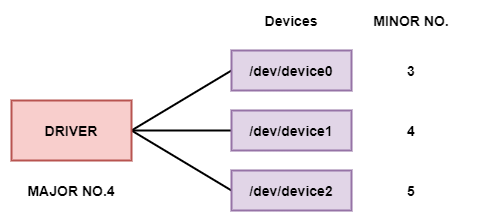
主设备号与次设备号
| 概念 | 作用 |
|---|---|
| 主设备号(major) | 通常标识驱动;应用打开节点时,内核据此找到对应驱动 |
| 次设备号(minor) | 区分同一驱动下的多个设备实例,传给驱动内部逻辑 |
| 设备节点 | 用户可见的名字(如 /dev/ttyUSB0),创建时绑定主/次设备号 |
现代内核允许更灵活的分配(含动态主设备号、共享主设备号等),但「主号找驱动、次号找实例」仍是最常用的理解模型。
现代系统多用 udev(或类似机制)根据内核事件自动创建 /dev 节点,一般不必手写 mknod;调试或极简环境里仍可能手动创建。
内核中的设备号表示
内核用 dev_t 保存设备编号(定义见 <linux/types.h>)。常见实现中,dev_t 为 32 位:高 12 位主设备号,低 20 位次设备号。
#define MINORBITS       20
#define MINORMASK       ((1U << MINORBITS) - 1)

#define MAJOR(dev)      ((unsigned int) ((dev) >> MINORBITS))
#define MINOR(dev)      ((unsigned int) ((dev) & MINORMASK))
#define MKDEV(ma, mi)   (((ma) << MINORBITS) | (mi))
宏定义见 <linux/kdev_t.h>。
申请与释放设备号(字符设备)
静态申请
若已知要用的编号范围:
#include <linux/fs.h>

int register_chrdev_region(dev_t first, unsigned int count, const char *name);
| 参数 | 含义 |
|---|---|
first | 起始设备号 |
count | 连续编号个数 |
name | 出现在 /proc/devices 等处的名称 |
| 返回值 | 成功为 0,失败为负错误码 |
动态申请(推荐新驱动默认做法)
int alloc_chrdev_region(dev_t *dev, unsigned int firstminor,
                        unsigned int count, const char *name);
成功时 *dev 为分配到的起始编号;主设备号可用 MAJOR(*dev) 取出。
释放
void unregister_chrdev_region(dev_t first, unsigned int count);
通常在模块退出路径中调用。
新驱动优先 alloc_chrdev_region() 动态分配,避免与他人静态主号冲突。动态主号意味着不能预先写死 /dev 节点,应配合 cdev + device_create / udev,或在加载后从 /proc/devices 读取再创建节点。
静态与动态结合的常见写法
if (scull_major) {
    dev = MKDEV(scull_major, scull_minor);
    result = register_chrdev_region(dev, scull_nr, "scull");
} else {
    result = alloc_chrdev_region(&dev, scull_minor, scull_nr, "scull");
    scull_major = MAJOR(dev);
}

if (result < 0) {
    pr_warn("scull: can't get major %d\n", scull_major);
    return result;
}
默认让 scull_major = 0 走动态分配,同时保留编译期 / 模块参数指定主号的余地(经典 LDD scull 示例思路)。
设备号分配参考
部分主设备号有传统约定,清单见内核文档 admin-guide/devices.txt(路径随内核版本可能调整)。广泛分发的驱动不要随意「挑一个看起来空闲的主号」。
小结
- 设备节点是用户空间访问字符 / 块设备的入口
- 主/次设备号把「文件名」关联到「驱动 + 实例」
- 新驱动优先动态申请设备号,并与 udev /
device_create配合